Showing posts with label Spain. Show all posts

Friday, 15 March 2013

Cordoba to Madrid

Today we took the AVE train from Cordoba to Madrid. AVE, which stands for Alta Velocidad Espanola, is the high speed train that can go up to 310 km per hour. It got us back to Madrid in less than two hours.
The Renfe, or Spanish train system, is known for a difficult website, though the web fares offer a significant discount. We found it not too bad, with some research and preparation. Your best bet is to read this extremely helpful article: A Beginner's Guide to Train Travel in Spain, which has a section on How to Use Renfe.com
AVE train, by rofi
It has invaluable information, and walks you through step by step, from setting up an account, why you want to have one, to searching for the train you want, and actually purchasing tickets; it was written byThe Man in Seat 61.


Street art in Madrid


Tuesday, 12 March 2013

Adventures in eating

First of all, mealtimes are different here. Breakfast is early, but lunch is anywhere between 1:30 and 4:00; this is the main meal of the day... after that there are always tapas.
At lunchtime there's often a Menu del dia, or menu of the day, or special. This includes an appetizer, entree, and dessert. Our favourite was in Granada, where for the appetizer Brad had paella and I had salad, and for the entree we both had tuna, which turned out to be enormous tuna steaks, and for dessert there was flan.
Also in Granada was a rather surprising meal: Brad had seafood soup, which included everything in its shell: clams and prawns; I ordered sole, and was surprised to have a plate put in front of me with two fish, bones included!
As soon as you order a drink, a small tapa usually follows: often olives, or a small vegetable dish. Also served is bread and breadsticks; there's always olive oil and vinegar on the table: for your salad, and also you put olive oil on your bread.
The draft beer is like light beer at home, and here in Southern Spain (not the case in the north we hear), you can order a small beer, called a cana. The red wine is very good, as is the sangria.
We've had some delicious tapas: deep fried eggplant with honey, mushrooms with garlic, artichokes with onions, prawns and potato...

Of course dessert is another whole category. The hot chocolate and churros in Madrid were delicious.
The confiterias (pastry shops) are outrageous with their extensive selection, and have to be tried.
There are small fruit stands and shops everywhere you go, and some have signs that say "don't touch the fruit!" You just say what it is you want, and the shopkeeper selects it for you.
Hot chocolate and churro, by Moyan Brenn CC


Saturday, 9 March 2013

More Jerez dressage school

Yesterday we went back to the Dressage school for a tour and to watch horses and riders training. There are a few different things you can study here: saddlery, riding, driving, to be a vet assistant, or a groom.
The most popular program is riding, and students can study for either two or four years; then they usually go home and become dressage instructors. To apply, you have to be between 16 and 24 years old, speak and write Spanish, and be a fairly high level dressage rider. As well as a written exam, applicants have to do a practical test, on one of the School's horses that they've never ridden before; they only get 10 minutes in the warm-up ring on the horse before the dressage test.
While on average 60 people apply every year, only 6 are accepted. Students pay only 1000 Euros per year, since the school provides scholarships, in order to encourage the best students to apply.
Our guide in the tack room
In contrast, private students pay 2000 Euros per week! We saw two of those in the ring; they're easy to identify as they wear whatever colour they want, whereas Dressage students wear green, and instructors wear dark blue. Fourth year students may be invited to ride in the exhibitions, like the one we saw yesterday; only two or three students were in it yesterday we were told, all the rest were instructors. There are 15 riding teachers and 2 driving instructors. Some of the instructors have been to the Olympics and also competed in the World Equestrian Games, which was held in Jerez in 2002.

There are 120 horses on site; all are stallions if they're pure Spanish horses, or geldings if they're a mixed breed horse. Most come from their own stud farm, but some come from the Military, as they're one of the sponsors of the school. The horses' training starts at age 3, and by the time they're 7 they may be participating in the Exhibitions. When they're 20 they're retired to the stud farm (the best), or sold.


A student lunging a horse in the outdoor arena with the indoor behind

After the tack room and stables, we walked over the Carriage Museum; one big carriage was used a few years ago for the King's daughter's wedding in Seville, the carriage was pulled by 6 bay horses. We then went to the arena to watch some training, and also walked through the saddlery. Each horse has his own made-to-fit saddle and bridle.

It was a very enjoyable tour; Brad did an informal survey of our tour group: most of the women were riders, the men were not. One fellow said "I just cut hay..."


Thursday, 7 March 2013

Jerez dressage

Dressage training by Alcalaina CC


This morning we walked to the Dressage School; it's so well known here, and so many people come to see their performances, all you need to say is "the school," and people know what you mean. Started in 1973, La Real Escuela Andaluza Del Arte Ecuestre (the Royal Andalucian School of Equestrian Art) trains riders in riding and driving. We saw individual riders (one woman and the rest men), four riders and then eight at a time, doing drill team moves. Two carriages, one with three horses and one with four performed, one doing such tight circles you held your breath.
No photos were allowed once the show started, so we only have the one below of a rider in the warmup ring at the end; people were starting to arrive.


The ring at the Dressage School
After that we walked around the corner to the Sandeman sherry cellar for a tour, tasting, and tapas. After learning that they use only American oak barrels, and much detail about the process, we got to the tasting room where we sipped three types of sherry: Palomino fino, much like a dry white wine, a medium sherry, very smooth, and a dark one which was really sweet. Two flamenco dancers performed on a small stage with a guitarist, which was a unexpected treat.

Our guide at Sandeman Cellar

Tuesday, 5 March 2013

Plaza de Espana and the University of Seville

We took the tram down to the Plaza de Espana, built as the Spanish pavilion for the World's Fair here in 1929. It's a giant semi-circle, with a moat, a fountain, and a huge plaza. Beautiful tiles represent each province of Spain, from A to Z.

Later we walked to the nearby University of Seville, which is housed in the old Royal Tobacco Factory. We each had a lemon Fanta in the student cafe, full of students with laptops; the cafe is a modern corner (modern tables, chairs and large glass doors) in an old building, but with marble floors. 


Brad on the Plaza de Espana
Our search for a laundromat led us past this great cafe where we enjoyed a snack and conversation
Inside the cafe were the usual hams hanging by a foot...

Monday, 4 March 2013

The Cathedral in Seville

The largest Gothic cathedral in the world is here is Seville. It's truly enormous! The tomb of Christopher Columbus is here; he died in 1506 and was first buried in Spain, then moved to the Dominican Republic, and on to Cuba. Once Cuba gained its' independence, his remains were sent back to Spain, to Seville. Doubts about whose bones were really in the tomb were laid to rest once and for all when DNA testing was done.
Beside his tomb is a giant mural of St. Christopher. In the Ornaments Room, we saw the jewelled crown, Spain's most valuable, with 11,000 precious stones. The enclosed choir space, with carved wooden choir chairs, is a separate area across from the high alter.

This church also has enormous columns, beautiful stained glass, and a large baptismal font in a side chapel that's still used today. Under glass, in a climate controlled display case, is the silk pennant Ferdinand III had raised over the mosque that once stood here (and was razed to make way for the cathedral), on November 23, 1248, when Christian forces expelled the Moors from Seville.

This gives you a sense of the size of the Cathedral
At last it was time to climb up the Giralda Bell Tower; it's 330' tall, and instead of stairs has a brick ramp - it was designed for riders on horseback - they would ride up five times a day to give the Muslim call to prayer, as it was formerly a Moorish minaret.

Detail on the crown
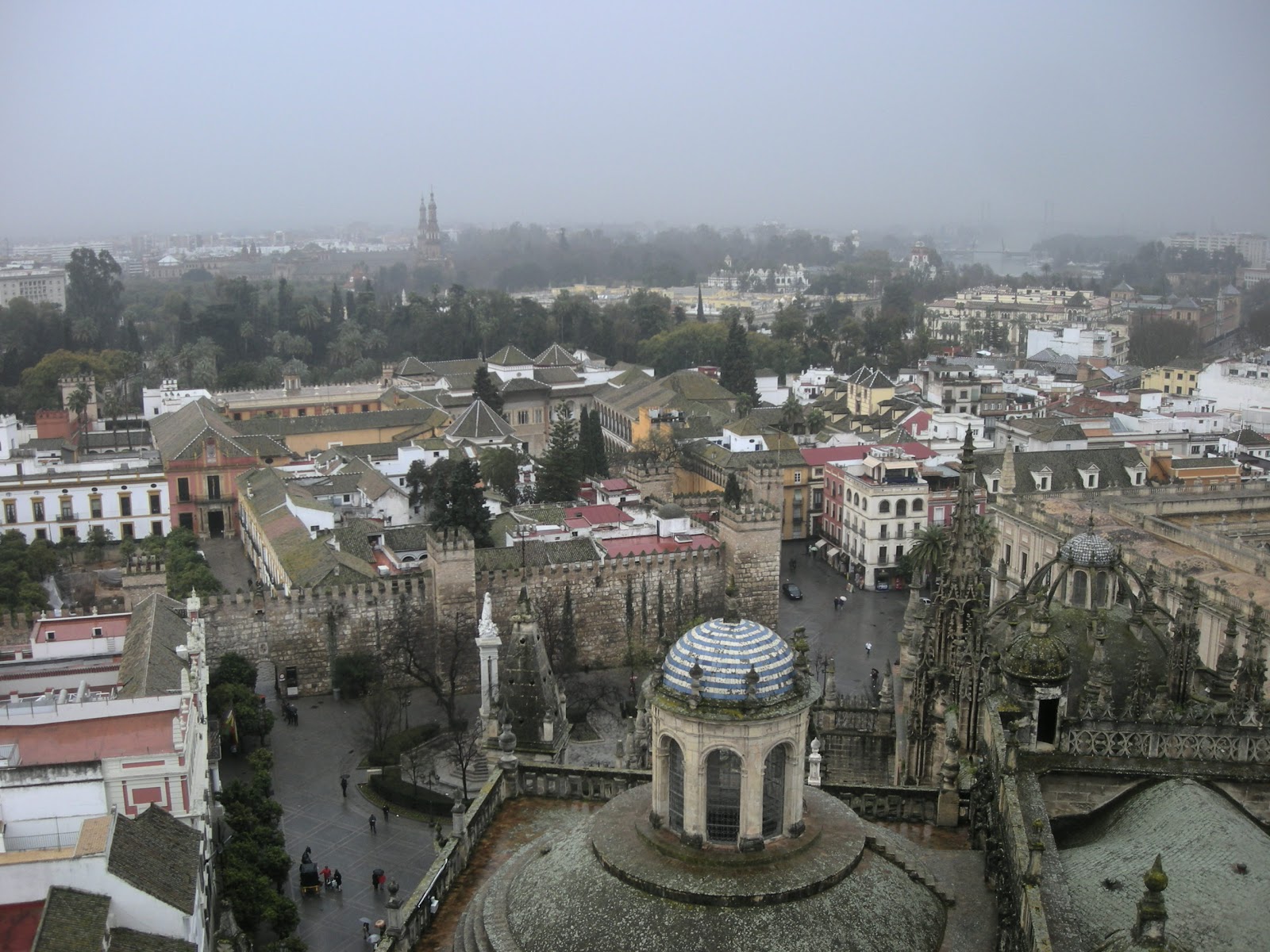
There were interesting views from the top - we could see down into the Alcazar where we were yesterday, we picked out Plaza Nueva, that we walk through every day to and from our hotel, we could see the river, and so on.  Just before we left, Brad asked an employee where we might find a good place for lunch, and were told of El Casario. We followed her directions, found the little street, and almost walked right by the tiny unassuming restaurant. With only 8 small tables and 8 stools at the long wooden bar, it was a bustling, very full place. Luckily two women left and we took their places at the bar. We ordered a salad, green beans with ham, and a fish dish, all to share.  "No fish today! It's Monday" we were told. This is because the fishers don't go out on Sunday, so there's no fish in the market. They only serve fresh fish! It was a very authentic place, with delicious food, full of locals; a real find!


Looking down from the bell tower to the Alcazar
 
Cake in a bakery window

Sunday, 3 March 2013

One Seville museum and the Alcazar

Part of the museum is in this former church
This morning we visited the Museo de Bellas Artes, an art museum in a beautiful building that was once a church and convent. It has Andalucia's top paintings, by Spanish masters Murillo and Zurbaran. It's a perfect setting for religious art; Murillo (1617 - 1682) was a very popular painter, and his art adorned churches both in Spain and in the Americas.
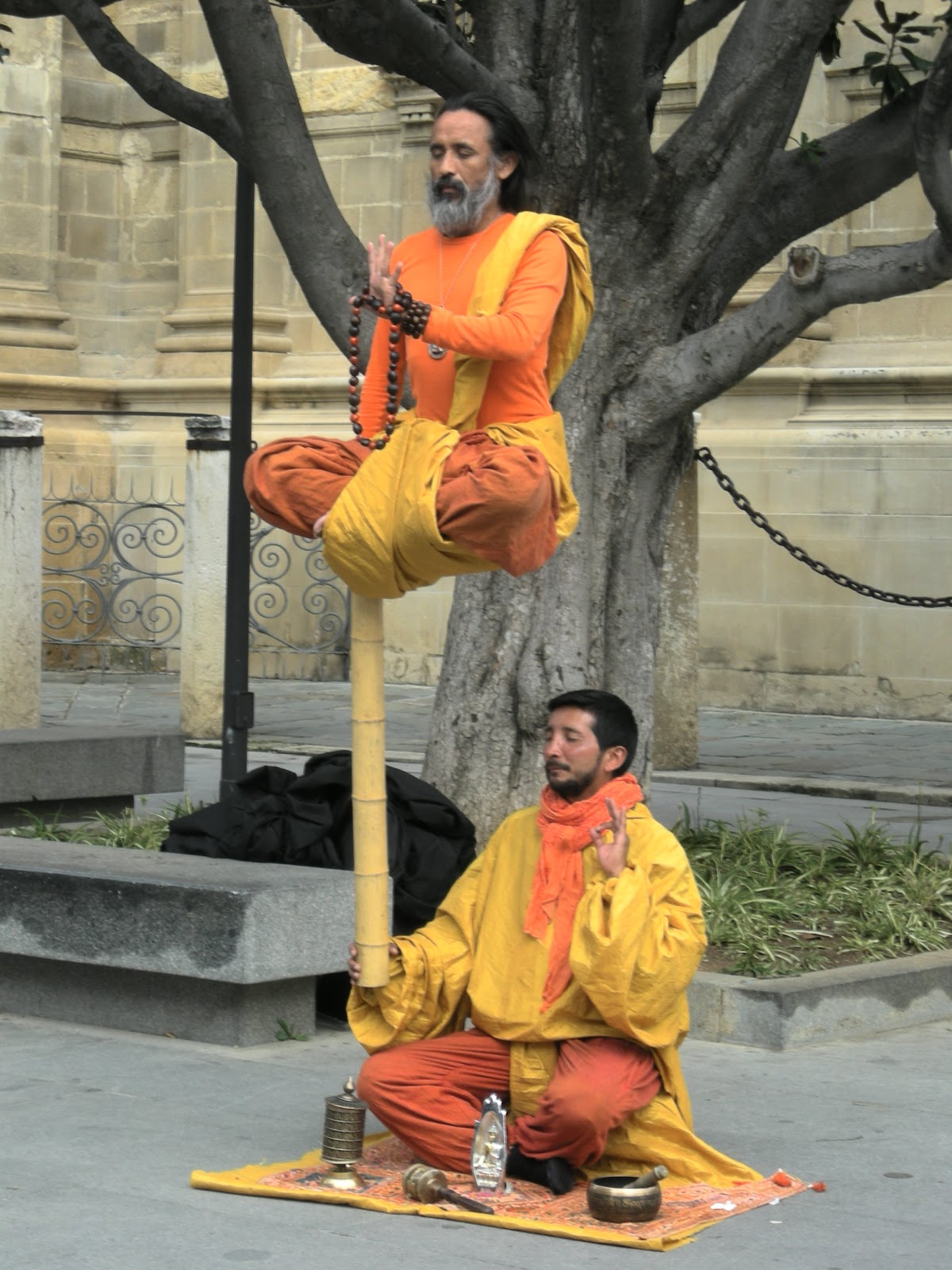
We walked down to the river and along the walking / cycling path, then up to the city centre again. Yesterday we saw street performers "levitating" - today we saw two really dressed for the part. When he heard you drop coins in the metal container, he gave the thumbs up sign.
 
In the afternoon we walked through the Alcazar, or Royal Palace, re-built by King Pedro I in the 14th Century. It's a fusion of Islamic and Christian styles. One cube-shaped room called the Hall of the Ambassadors had a domed ceiling that was incredible. Another impressive room was the Hall of Tapestries upstairs - one giant tapestry, of wool and silk, was an upside down map, with Africa at the top and Italy at the bottom!


Yarn bombing in Plaza Nueva
Part of the garden behind the Alcazar palace


Saturday, 2 March 2013

Seville

A two hour direct bus ride was all it took to escape the bitter cold of Ronda, a beautiful hill town. Seville is at a lower elevation, and a lot warmer; we even sat at an outside table for lunch. The first thing we noticed about Seville, other than the temperature, was how bike friendly it is. We also enjoyed lots of street performers, probably out in force since it was a Saturday.
 
Cyclists gather - notice the beer - we're not in BC anymore...
Hip hop on the Plaza Nueva, by the Seville Dance Center students
Performer getting ready...
This is the one fellow above; the woman's feet are actually his hands in the boots...
Stylin' dog out for a Saturday afternoon walk...
 

Friday, 1 March 2013

Ronda

A day of discoveries: we found Confiteria Daver, just in time for morning coffee; they have an incredible selection of pastries.
Almost at the bottom
We found the trail down to the river, at the bottom of the "new bridge" built in 1793; it started as wide stone steps, but soon got rather narrow, until it was a tiny trail hugging the side of the cliff. We kept expecting it to end, but at the bottom of the bridge there were metal stairs going down to a concrete catwalk that took us under the arch, so that we were right beside the rushing blue-green water.
We found the Museo del Bandoleros (Bandit Museum), a small but fascinating place full of artifacts, documents, photos, books, and life-size dioramas. They even had an old bandit movie playing.
This evening we found our way to a concert of Musica Sacra (Sacred Music) in what used to be a chapel, but is now an art gallery. The narrow space had a ceiling that had to be 50 feet tall. With a white ceiling, walls that were two-thirds white and one third (at the top) orange-red, it was a bright, inviting venue. The musicians played the organ (keyboard), violin, and trombone. The fellow on the organ had the most expressive eyebrows and face, it was almost as entertaining watching him attend to his notes and fellow musicians as it was listening to the music, which was delightful.
From the bottom looking back at the bridge

A bandit? No, he tied up his horse then put out a sign saying for 2 euros you can take my picture!

Thursday, 28 February 2013

Snow falling on orange trees

Snow on the orange trees in the square
Imagine our surprise to wake up, look out the window and see snow falling this morning! We heard it was the first snow in five years. It was also Andalucia Day, which meant a holiday for school children.


We caught a train to Ronda, a small hill town to the west, perched on the side of a gorge. Walking around, we saw a high school band, and men carrying a heavy looking platform. This we thought was a protest of some sort, but when we asked, it turned out to be a practice session for Semana Santa (Easter), when they'll carry a heavy statue.
Bridge between the old and new parts of Ronda

Men in training for the Easter procession

Wednesday, 27 February 2013

The Royal Chapel in Granada

This morning we walked through the Royal Chapel, beside the Cathedral. This 16th Century Gothic chapel has the marble tombs of Queen Isobel (Isobel la Catolica) and King Ferdinand. The enormous and intrically carved tombs were made in Italy and shipped here. Narrow steep stairs take you down to the crypt where the actual caskets and remains are. This is also where their son and daughter-in-law rest: Philip the Fair and Juana the Mad! Who said history is dull?
Further along in the Sacristy/Museum is a glass case with Isobel's silver crown, decorated with silver pomegranates, the symbol of Granada. We saw various textiles, and a small collection of religious paintings on wooden panels, one done by Botticelli.
Brad buys fruit
Town Hall in Granada
Don Quixote dining al fresco
After that we did a lot of walking: we found the Town Hall, and admired the courtyard and tiles inside, we walked to the Jewish Quarter and happened upon a small guitar shop; through the window you could watch the luthier at work. We couldn't resist going inside; the owner himself came out to explain that he had a one year wait list for hand made guitars.
Tapas bar near the cathedral
Isobel & Columbus statue by day

 
Columbus and Queen Isobel statue by night; the fountain only appears after dark.

Tuesday, 26 February 2013

Alhambra in Granada

Ideal photo by Aidarile CC
Today we took the local bus up the winding narrow streets to the Alhambra, originally a walled city and Moorish palace. We started in the gardens, where workers were busy pruning; it must take a small army of gardeners to maintain all of the flower beds, hedges, and roses and other bushes.
As the gardens are at the top of the site, the views are incredible: the palace below, the snowy mountains in the distance, the city below, and the Albayzin (the Moorish quarter with all white dwellings) across the gorge on the next hill.
Courtyard of the Myrtles
We just had time to get through the very interesting museum, with interesting pottery, textiles and metalwork, when it was our time to go into the Palace. Again we had an audio guide, which was invaluable in explaining the rooms functions, the Arabic script, the tilework and so on. Theses are two photos of the Courtyard of the Myrtles; the first is what you hope for, a fabulous shot, but we were rather disappointed when we got there, to see scaffolding in place!
The viewpoint is beside the tower 
After the palace we found the Parador de Granada San Francisco and had lunch; a parador is a government run hotel in an historic building. Imagine staying right in the Alhambra!
The Alhambra from the viewpoint
 
Following a twisting path, we walked down the hill to the river, and back up winding cobbled streets in the Moorish quarter to the Mirador San Nicolas - the viewpoint where you can watch the sun setting on the Alhambra. It was quite a scene with craft vendors, four guitarists, a wandering photographer with a polaroid camera, and of course tourists like us.

Down by the river


Gato in the garden

Monday, 25 February 2013

Train from Madrid to Granada

Atoche train station, Madrid, by alanak CC
 
Today we got a taxi to the train station, went through security, found out which platform we needed to be near, and just had time to get some coffee and food to go before it was time to board. We'd been able to buy and print our tickets before we left home, so it was only a matter of having the attendant scan our printout and minutes later we were in our seats.
It was a comforable 4 1/2 hour ride to Granada. We passed fields of sheep, and row upon row of olive trees. After Cordoba the landscape became hilly, and as we approached Granada we could see the snow covered Sierra Nevada mountains in the distance.

Sunday, 24 February 2013

Sunday in Madrid

We spent a good portion of the day in the Prado; with our map and audio guide, we roamed from room to room in this incredible art museum. It's a good thing the building itself is huge, as a lot of the canvases are enormous. We made sure we saw Velazquez's Maids of Honor, Goya's work, Rubens and Titian. There are also several of Durer's paintings, including his self-portrait. Hieronymus Bosch's Garden of Earthly Delights triptych is also there.
There was so much to see we had to visit the cafe to restore our energy, where a 250 ml bottle of orange juice cost an astonishing 5 euros! That's $6.76 CDN!
The hanging garden outside CaixaForum
 
Next we walked down the wide boulevard Paseo del Prado, where the demonstration had been the night before, to the modern art museum CaixaForum. Before going in we had a look at the "hanging garden" outside. Inside there were exhibits on food insecurity, maestros of chaos, and, the best one: cartographies (artists interpret maps of all kinds).
We ended the day by searching out the famous Chocolateria San Gines, where the hot chocolate is so rich and thick you don't drink it, but dip your churros in it; they're long deep-fried crispy donut-like bites of heaven. A popular place, the line-up to get into the tiny place was to the door; you pay, and then take your receipt to the counter to pick up your order, then move to a ledge to enjoy your treat. It's a standing room only place, unless you want to wait for a table in the back room.

Saturday in Madrid

Plaza Mayor
 
It was crisp, clear and sunny as we set off on a self-guided walking tour. First stop was Plaza Mayor: a vast, cobbled square that's seen a lot of history, including "trials" during the Inquisition. We looked in some of the shops: a hat store, coin and stamp shop, a bar full of bull's heads and bullfighting memorabilia.
Next we went into the San Miguel public market, a steel and glass structure from 1916 - it was packed with people at the wine and cheese bars, deli stalls, fruit stands and so on. Around a few corners and up a narrow lane we found the oldest door in Madrid, made of wood and iron, in the oldest building in the city, built in 1480!
Soon we were at the Almudena Cathedral, an enormous one only finished in 1993; it took 100 years to finish! Inside we enjoyed the sun lighting up the large stained glass windows, the Neo-Gothic interior and painted ceilings.
The Royal Palace
Next door, we lined up for tickets to the Royal Palace, at 1.5 million square feet, it's Europe's largest. We moved from one over-the-top room to the next. While not lived in by the royal family anymore, it's still used for formal occasions, ceremonies and dinners. One highlight was the Gasparini Room, the King's dressing room: Rococo in style, with a frescoed ceiling, silk-embroidered walls, chandeliers, and multi-coloured marble floors.
After all that we actually thought we would carry on down to the Prado, but each road we tried was blocked by police barricades, and we eventually realized there was a huge demonstration going on - thousands protesting the government austerity measures. People coming up the hill were carrying" No Cuts" signs.